


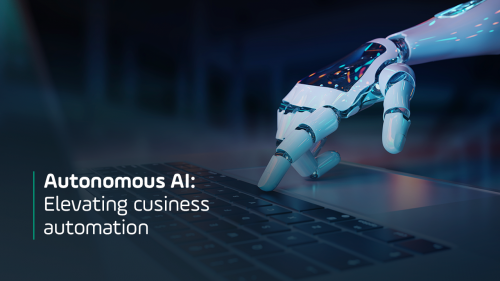
Autonomous AI: Elevating Business Automation
What is Autonomous AI and how does it differ from conventional AI?
In today's world, where operational efficiency and agility are indispensable for competitiveness, companies are constantly seeking ways to innovate. Traditional Artificial Intelligence (AI) already plays a crucial role in this scenario, automating routine tasks and optimizing processes. However, a new concept is beginning to stand out and promises to revolutionize even further how businesses operate: Autonomous AI.
But after all, what differentiates Autonomous AI from conventional AI?
Conventional AI is programmed to execute specific tasks, heavily depending on human intervention for training, supervision, and adjustments. It follows predefined rules and needs constant monitoring to improve its performance and correct deviations. In contrast, Autonomous AI goes beyond: it involves systems capable of making independent decisions, adjusting their own algorithms in real time, and learning continuously without the need for direct supervision.
These solutions employ technologies such as advanced machine learning, deep learning, autonomous agents, and dynamic neural networks, enabling machines to not only execute tasks but also adapt strategies based on new data and scenarios. This means that autonomous systems can evaluate complex situations, identify opportunities or threats, and act quickly without the need for human validation for each decision.
Challenges and risks of complete autonomy in decision-making
Despite numerous benefits, implementing Autonomous AI is not exempt from challenges. One of the main issues involves the ethical and responsibility aspects associated with delegating critical decisions to automated systems.
Ethical and responsibility implications
Complete autonomy raises important questions: who is responsible for a decision made by a machine? How to ensure that these decisions don't present harmful biases? To address these concerns, companies need to establish clear accountability policies and maintain human oversight at critical points.
Additionally, ensuring algorithmic transparency is fundamental. Explainable tools (Explainable AI – XAI) allow professionals to understand how decisions were made, mitigating legal and reputational risks.
Risks associated with lack of human supervision
Another challenge is related to the possibility of failures or systemic errors. Autonomous systems can be vulnerable to cyberattacks, technical failures, or incorrect data interpretation. To minimize these risks, some essential measures include:
-
Audits and continuous system monitoring.
-
Definition of operational limits, preventing systems from acting outside acceptable parameters.
-
Human redundancy for critical decisions and exception control.
How Mouts IT can help in Autonomous AI implementation
Adopting autonomous solutions demands deep technical knowledge, integration with legacy systems, and special attention to security. Mouts IT offers a complete range of services to help your company in the safe and efficient implementation of this disruptive technology.
Services offered by Mouts IT for autonomous system integration
✅ Personalized consulting for diagnosing processes suitable for autonomous automation.
✅ Development and implementation of autonomous agents adapted to your business reality.
✅ Integration with existing systems (ERP, CRM, IoT) ensuring operational fluidity.
✅ Team training so they understand and supervise systems with confidence.
Mouts IT's differentials in safe and efficient Autonomous AI adoption
Our approach combines technical expertise with strategic focus, allowing your company to adopt Autonomous AI without compromising security or organizational culture. We offer:
-
Robust data governance, ensuring compliance and protection of sensitive information.
-
Agile methodologies for rapid implementation and adjustments as needed.
-
Constant monitoring and specialized support, minimizing risks and ensuring continuous efficiency.
Conclusion
Autonomous AI is redefining what we understand by business automation, offering a model where systems are capable of learning, deciding, and acting independently. Companies that embrace this technology experience significant gains in efficiency, cost reduction, and operational agility.
However, its adoption requires careful planning, risk mitigation, and specialized support to ensure sustainable results.
Ready to take your company's automation to the next level? Contact Mouts TI and discover how Autonomous AI can transform your business!
Related news
Innovation, the global market and divers topics about the technology universe are currently available on our blog.
 Cases
Cases
Big Data in energy: how to manage data in the energy sector?
The energy sector is one of the fundamental pillars of the global economy, driving everything from large industries to domestic consumption. With the advancement of digital technologies, the amount of data generated in this sector has increased exponentially, making Big Data an essential tool for companies seeking to stand out in a competitive market. But how to collect and analyze this data effectively? And what are the benefits of a well-done analysis?
 Cases
Cases
Energy and sustainability: 3 innovative technologies in the energy sector
Sustainability has become a central issue in the energy sector, driven by the need to reduce environmental impact, ensure energy security and meet growing demands for cleaner energy sources. With increasing pressure to reduce carbon emissions and adopt more sustainable practices, the sector faces significant challenges, but also promising opportunities.
 Cases
Cases
Why is cloud migration important for the energy sector?
Energy market professionals can already see that the sector is undergoing a significant transformation, driven by the need for greater efficiency, sustainability, and innovation. Amid these changes, cloud migration has stood out as one of the main strategies for companies looking to optimize their operations, reduce costs and improve collaboration.