


Hybrid AI: The Perfect Combination Between Humans and Machines in the Corporate World
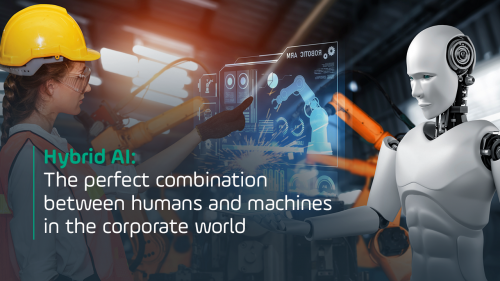
Artificial Intelligence (AI) is becoming increasingly embedded in business environments, but a major question remains: did it come to replace humans or to enhance their work? The answer lies in Hybrid AI, a model that combines the speed and precision of artificial intelligence with creativity, critical thinking, and human experience.
This approach allows companies to automate processes without sacrificing strategic control, ensuring efficiency, innovation, and better decision-making. Major enterprises are already applying this technology to optimize operations and drive results.
But how does Hybrid AI work in practice? How can it be integrated into the corporate world without compromising the human factor? In this article, we'll explore the benefits of this combination and how your company can leverage this technological revolution.
What is Hybrid AI and Why is it the Future of Business?
Unlike traditional artificial intelligence models that autonomously replace manual processes, Hybrid AI integrates machines and humans to work together in a complementary manner.
While algorithms analyze large volumes of data and automate repetitive tasks, professionals interpret these insights, make strategic decisions, and add an essential human factor to operations.
Practical Example: In customer service, an AI-powered chatbot can instantly respond to simple queries, while a human agent steps in to resolve more complex demands that require empathy and negotiation.
With this approach, companies can scale operations without losing personalization and quality, creating an ideal balance between efficiency and human control.
Benefits of Hybrid AI for Businesses
Hybrid AI brings numerous advantages to the corporate world, allowing companies to innovate without compromising human supervision. Here are some key benefits:
1. The Best of Both Worlds
- AI processes and analyzes large volumes of data quickly, identifying patterns and trends that would go unnoticed in human analysis
- Humans interpret results, contextualize, and apply the best strategy for the business reality
Example: In market analysis, AI can identify emerging trends, but the final decision on investment or strategy is still made by specialists.
2. Automation Without Loss of Control
- AI optimizes repetitive and bureaucratic processes, reducing operational costs
- Managers and analysts monitor and supervise automated decisions, ensuring greater reliability
Example: In the financial sector, AI can automatically identify suspicious transactions, but a human specialist verifies and decides whether the operation should be blocked or approved.
3. Error Reduction and Improved Decision-Making
- AI learns from patterns and data history, reducing failures and inconsistencies
- Professionals validate and refine strategy to avoid decisions based solely on statistics, bringing the human factor to optimize results
Example: In retail, AI systems can predict product demand based on previous data, but a manager can adjust orders considering external factors like seasonality and unforeseen events.
4. Scalability and Personalization
- Hybrid systems adapt to business needs, ensuring flexibility and sustainable growth
- Each company can customize the balance between AI and human supervision according to sector and strategic objectives
Example: In e-commerce, product recommendations can be generated by AI, but the marketing team can adjust campaigns based on emotional and cultural factors specific to the target audience.
Hybrid AI in Practice: How Companies Are Already Using This Technology
Hybrid AI is already applied across various sectors, helping companies maximize efficiency without losing quality in service and decision-making.
Customer Service
- AI-based chatbots resolve simple issues and free agents for more complex cases
- According to McKinsey research, AI-enabled customer service transformations can achieve a 40 to 50 percent reduction in service interactions while maintaining quality and improving customer experience¹
Strategic Decision-Making
- AI analyzes market trends, consumer behavior, and financial risks
- Final decisions, however, are made by managers and specialists, considering human and strategic factors
Predictive Maintenance
- AI monitors equipment and predicts failures before they happen, reducing maintenance costs
- Technical teams use these predictions to act preventively, avoiding unexpected shutdowns
Relevant Data: According to an Accenture survey of 2,000 executives, 77% expect employees and intelligent machines to increasingly work side-by-side in a collaborative way².
How Mouts IT Can Help Your Business Implement Hybrid AI
Mouts IT specializes in implementing Hybrid AI solutions, ensuring your company integrates artificial intelligence without compromising human supervision.
What We Offer:
- Specialized consulting to map processes and identify automation opportunities
- Customized AI solutions combining machine learning, predictive analytics, and business intelligence
- Implementation and continuous support to ensure technology adaptation and optimization in your business
With Mouts IT, your company can scale operations efficiently without losing human intelligence and sensitivity!
Conclusion: The Perfect Balance Between Technology and Humanity
Hybrid AI didn't come to replace professionals, but to enhance their abilities. Companies that adopt this approach can reduce costs, increase efficiency, and make more strategic decisions without sacrificing the human touch essential for innovation and personalization.
The future of AI isn't 100% automated, it's collaborative! Companies that understand this synergy get ahead in the digital transformation era.
Ready to discover how Hybrid AI can transform your company? Contact our specialists and start implementing this innovation today!
Key Statistics:
- 77% of companies expect collaboration between humans and machines in AI implementation (Accenture)
- 40-50% reduction in service interactions with AI-enabled customer service without quality loss (McKinsey)
Transform your business operations with the perfect balance of artificial intelligence and human expertise. Our team delivers measurable results through strategic AI implementation.
Related news
Innovation, the global market and divers topics about the technology universe are currently available on our blog.
 Cases
Cases
Big Data in energy: how to manage data in the energy sector?
The energy sector is one of the fundamental pillars of the global economy, driving everything from large industries to domestic consumption. With the advancement of digital technologies, the amount of data generated in this sector has increased exponentially, making Big Data an essential tool for companies seeking to stand out in a competitive market. But how to collect and analyze this data effectively? And what are the benefits of a well-done analysis?
 Cases
Cases
Energy and sustainability: 3 innovative technologies in the energy sector
Sustainability has become a central issue in the energy sector, driven by the need to reduce environmental impact, ensure energy security and meet growing demands for cleaner energy sources. With increasing pressure to reduce carbon emissions and adopt more sustainable practices, the sector faces significant challenges, but also promising opportunities.
 Cases
Cases
Why is cloud migration important for the energy sector?
Energy market professionals can already see that the sector is undergoing a significant transformation, driven by the need for greater efficiency, sustainability, and innovation. Amid these changes, cloud migration has stood out as one of the main strategies for companies looking to optimize their operations, reduce costs and improve collaboration.