


Rework in your operation: where it’s born and what it costs the company

Rework almost never shows up on the P&L. It has no line of its own in the budget, it triggers no system alert, and it rarely makes the board’s agenda. Even so, it consumes the hours of skilled people, delays deliveries, and eats into margin every single day.
The broader impact of process inefficiencies has been studied. In its 2023 Anatomy of Work Global Index, Asana reported findings from a survey of more than 9,600 professionals across six countries. On average, 58% of the day went to work around the work: searching for information, switching between systems, chasing status, and redoing what had already been done. The respondents themselves estimated they’d gain 4.9 hours a week with better processes. In other words, that adds up to more than six working weeks a year, per person.
And yet rework in companies is still usually treated as someone’s mistake. In practice, it’s a symptom of how the process was designed. So this article shows where it’s born, how to estimate what it costs, and why automating without a diagnosis can multiply the problem instead of solving it.
Read also: Hyperautomation with AI: How to Make Your Operation More Efficient
Where rework is born: four points that keep repeating
Rework shows up at the review stage, but it’s born before it. In most operations, it arises at four points.
1. In the handoff between teams
Every time information changes hands, it gets reinterpreted. First sales records it one way, then operations understands it another, and finally finance sends it back to be corrected. An incomplete form bounces back. In the same way, an email with no attachment triggers another exchange. In an HR project handled by Mouts, for example, hiring an employee depended on a sequence of emails between teams.
2. In re-keying
The same data typed twice, into two systems, is the most predictable source of error. Research compiled by Raymond Panko shows that human error rates vary depending on the task. Even at a hypothetical error rate of 0.5%, 1,000 manual entries would translate to approximately five errors.
3. In the exception the system doesn’t cover
The ERP handles the standard case. On the other hand, the business’s specific rules, like an allocation, a commercial condition, or a split between units, tend to become manual work. That’s what happened at a credit union handled by Mouts: the accounting system made the simple entry, and the team completed the rest by hand, every day.
4. In the spreadsheet that became a system
When systems don’t talk to each other, the side spreadsheet appears. It starts out temporary and becomes part of the process. The risk is well known: In a review of 85 spreadsheets examined through intensive audits, researcher Raymond Panko reported errors in 94% of them.
What rework costs: three layers the budget doesn’t see
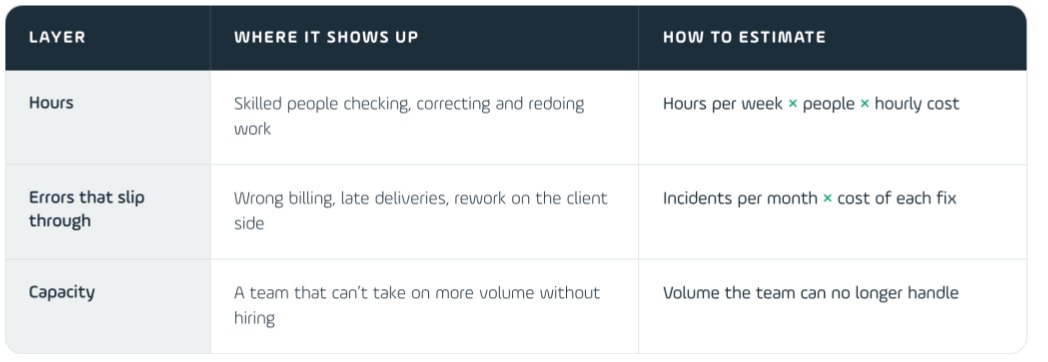
The cost of rework has three layers. Only the first is easy to calculate, and even that one almost never is.
Layer 1: the hours
The math is simple. To illustrate the potential cost of process inefficiencies, consider a team of five people who could each save 4.9 hours per week through better processes. At an illustrative hourly cost of US$50 over 48 working weeks, that represents US$58,800 per year.

The hourly rate is illustrative. It’s worth redoing the math with your operation’s numbers.
Layer 2: the error that slips through
Not every error is caught at review. Researchers George Labovitz and Yu Sang Chang proposed, in the early 1990s, what’s known as the 1-10-100 rule. Preventing an error at the source costs 1. Fixing it later costs 10. Letting it reach the customer costs 100. The numbers are an order of magnitude, not a measurement. Even so, they explain why the most expensive rework is the kind no one catches in time.
Layer 3: capacity
This is the layer that weighs most on planning. A team busy correcting doesn’t absorb growth, so rising volume turns into hiring. The ASQ, the leading international association for quality management, estimates that quality-related costs, visible and hidden combined, frequently reach 25% of sales or more. Rework is one component of that cost.
Why rework persists, even when everyone sees it
If rework is so expensive, why does it continue? There are three reasons, and none has to do with lack of effort from the team.
It’s distributed. Rework shows up as ten minutes here and twenty there, spread across several people and teams. Since no one loses a whole day, no one owns the problem.
It becomes a skill. In every operation there’s someone who knows how to fix what the system gets wrong. That person is valued, and rightly so. But the heroics hide the flaw in the process, and the company comes to depend on whoever knows the workaround.
The metric measures output, not the return trip. Most indicators count how many orders, entries, or hires were processed. Few count how many went back a step. So an area with a lot of rework can look productive on the report.
How to measure rework in your operation in two weeks
You don’t need a big project to measure rework. Two weeks of observing a single process already show the size of the problem.
- Pick a process with volume. Orders, hires, accounting entries, or credit analyses work well, because they repeat many times a day.
- Flag everything that goes back a step. For each item sent back, note the reason: missing data, wrong data, a rule the system doesn’t cover, or a stalled approval.
- Calculate the first-pass rate. Divide the items completed with no returns by the total processed. This is the indicator almost no team tracks.
- Time a sample of corrections. Ten or fifteen cases are enough to estimate the average time of each rework.
- Group the reasons. Usually, two or three reasons account for most of the returns. They’re the starting point.
In the end, you’ll have two results: the cost of rework in hours and a list of causes, ranked by weight. With that, the decision about what to automate stops being guesswork.
Process automation: when it solves rework and when it just speeds it up
Process automation is the natural answer to rework. Even so, it can create new rework when it’s applied on top of a process no one mapped.
A Workday survey, conducted in November 2025 with 3,200 professionals, shows this effect with artificial intelligence. Nearly 40% of the time saved with AI comes back as correction work: redoing text, fixing errors, and checking results. As a result, only 14% of respondents said they got a clear, consistent net gain. In other words, the technology saved time on one end and handed part of it back on the other.
The result changes when automation starts from the cause of the rework, not from the most visible task.
The HR process mentioned at the start of this article is an example. The rework wasn’t in the hiring itself, but in the email exchange between teams: each incomplete request bounced back, and each approval sat waiting for a reply. After Mouts mapped and automated that path, hiring became 40% faster, and errors dropped 30%.
The same logic applies to high-volume operations. In a card-application operation, each request took 8 minutes. With the process redesigned and automated, the time fell to 2 minutes and errors dropped 95%. As a result, the same team came to handle four times as many requests, without growing.
In both cases, the starting point was a manual process no one had stopped to map. After all, automating a poorly designed process only makes the error happen faster.
Where to start reducing rework
Rework doesn’t disappear with more attention from the team, nor with a new tool placed on top of the process. On the contrary, it shrinks when the company finds out where it’s born, measures what it costs, and attacks the causes that weigh most.
The first step fits in a question: how much of your team’s time goes to redoing what’s already been done? If the answer is “we don’t know,” that’s already the diagnosis.
Talk to a Mouts specialist in process automation. Together, you’ll map a process in your operation, estimate the cost of rework, and define where to start.

Related news
Innovation, the global market and divers topics about the technology universe are currently available on our blog.
 Cases
Big Data in energy: how to manage data in the energy sector?
The energy sector is one of the fundamental pillars of the global economy, driving everything from large industries to domestic consumption. With the advancement of digital technologies, the amount of data generated in this sector has increased exponentially, making Big Data an essential tool for companies seeking to stand out in a competitive market. But how to collect and analyze this data effectively? And what are the benefits of a well-done analysis?
 Cases
Energy and sustainability: 3 innovative technologies in the energy sector
Sustainability has become a central issue in the energy sector, driven by the need to reduce environmental impact, ensure energy security and meet growing demands for cleaner energy sources. With increasing pressure to reduce carbon emissions and adopt more sustainable practices, the sector faces significant challenges, but also promising opportunities.
 Cases
Why is cloud migration important for the energy sector?
Energy market professionals can already see that the sector is undergoing a significant transformation, driven by the need for greater efficiency, sustainability, and innovation. Amid these changes, cloud migration has stood out as one of the main strategies for companies looking to optimize their operations, reduce costs and improve collaboration.