


Software Development Engagement Models: Project, Squad, or Staff Augmentation?

Many technology hiring decisions start with the wrong question. Teams debate headcount or the engagement model before defining what really matters: which problem needs solving. And that's where the cost shows up before the project even starts. Choosing between software development engagement models should begin there, not with the size of the team.
A few mismatches are common. A company hires individual professionals when it actually needs someone accountable for the full delivery. It locks a rigid scope for a product that will keep evolving. It contracts a squad but manages each person as an isolated resource. Or it expects autonomy from a team without providing priorities and internal leadership.
Project, squad, or staff augmentation can all bring in equally qualified professionals. What changes is who defines the path, how the work evolves, and where the responsibility for delivery sits.
Before comparing models, define what you need
The first step isn't choosing the size of the team. It's understanding what the company is really after. In general, there are three different needs:
- a defined delivery, with a beginning, middle, and end;
- a continuous capacity to evolve a product or process;
- additional skills to reinforce an internal team.
At first, these needs look similar. In practice, however, each one calls for a different management structure. That clarity is what guides the choice among the three software development engagement models.
Software development engagement models in practice
Fixed-scope project
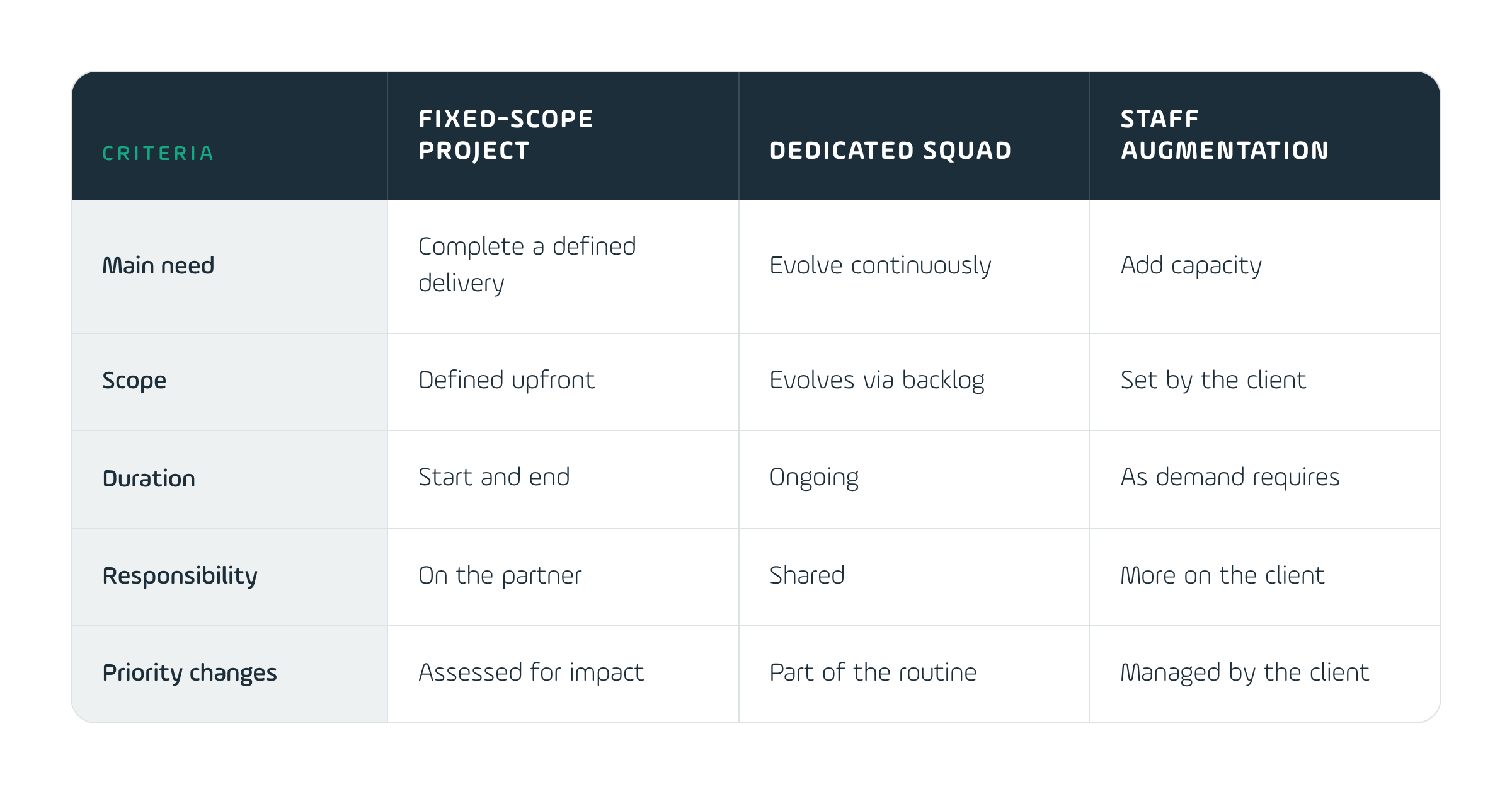
It starts from a defined objective, scope, timeline, and acceptance criteria. The technology partner is responsible for delivery within the agreed scope, and relevant changes go through an impact assessment on deadline and cost.
It works best when the result is clear, the requirements are stable, and there's a date to start and finish. Think of a specific integration, a bounded system migration, or the automation of a known process. On the other hand, it tends not to fit when priorities shift constantly or the scope still depends on discovery.
Read also: How to Ensure Quality in Software Projects
Dedicated squad
A multidisciplinary team works continuously on a product, platform, or business journey. The squad receives objectives, organizes the backlog, and delivers in short cycles, with operational autonomy and frequent collaboration with the client.
It works best when the product will keep evolving, the backlog changes with each learning, and the business needs to stay closely involved. One distinction matters here: a squad isn't just a group of professionals, it's a delivery unit, with a shared goal and a routine of its own. It's not the best fit for a one-off, fully bounded demand.
Read also: Squad as a Service: Revolution in IT Project Delivery
Staff augmentation
Professionals with specific skills join the client's workflow and technical management. Here, the client keeps more control over priorities, architecture, and pace.
It works best when internal technical leadership already exists, the backlog is organized, and the gap is capacity or a specific skill. In contrast, it doesn't work when the company expects the vendor to own the result alone, without internal management to steer the work.
Software development engagement models: the differences at a glance
How to choose: three questions that settle it
When in doubt, answer three questions.
- Does the demand end, or will it keep evolving? If there's a delivery with a clear finish line, think project. If the product will keep receiving new priorities, a squad offers more flexibility. If the goal is to expand the team for a period, staff augmentation fits better.
- How closely does the team need to integrate with the business? Delivery guided by defined requirements points to a project. Continuous conversation with users and departments calls for a squad. Working within existing processes and leadership points to staff augmentation.
- How much control over the pace does the company want to keep? Tracking milestones pairs with a project. Taking part in priorities while preserving the team's autonomy pairs with a squad. Directly steering execution pairs with staff augmentation.
The models can also coexist
The decision doesn't have to apply to the whole company. A project can build the first version of a solution, and a squad can take over its evolution. An augmented specialist can temporarily reinforce a squad. A larger modernization can be split into defined fronts and continuous ones. What matters is making the responsibilities, governance, and success criteria clear for each front.
What to align before signing
Before closing, it's worth agreeing on a few points: what will count as success, who defines and prioritizes the backlog, who owns the technical decisions, how scope changes will be handled, and which metrics will track the partnership. These answers prevent the kind of noise that only surfaces mid-project.
Choosing the model is already part of the solution
Mouts IT works with projects, dedicated squads, and staff augmentation. But the choice of format comes before the composition of the team. First, we understand the challenge, the maturity of the operation, the level of autonomy required, and the expected result. Only then do we structure the model best suited to turning investment into real execution capacity.
After all, project, squad, and staff augmentation aren't different names for the same contract. Each one distributes autonomy, management, and responsibility for results in a distinct way.
Not sure which model makes sense for your challenge? Talk to Mouts IT before defining the structure of your engagement.

Related news
Innovation, the global market and divers topics about the technology universe are currently available on our blog.
 Cases
Big Data in energy: how to manage data in the energy sector?
The energy sector is one of the fundamental pillars of the global economy, driving everything from large industries to domestic consumption. With the advancement of digital technologies, the amount of data generated in this sector has increased exponentially, making Big Data an essential tool for companies seeking to stand out in a competitive market. But how to collect and analyze this data effectively? And what are the benefits of a well-done analysis?
 Cases
Energy and sustainability: 3 innovative technologies in the energy sector
Sustainability has become a central issue in the energy sector, driven by the need to reduce environmental impact, ensure energy security and meet growing demands for cleaner energy sources. With increasing pressure to reduce carbon emissions and adopt more sustainable practices, the sector faces significant challenges, but also promising opportunities.
 Cases
Why is cloud migration important for the energy sector?
Energy market professionals can already see that the sector is undergoing a significant transformation, driven by the need for greater efficiency, sustainability, and innovation. Amid these changes, cloud migration has stood out as one of the main strategies for companies looking to optimize their operations, reduce costs and improve collaboration.