


Why traditional IT metrics are distorting strategic decisions in companies
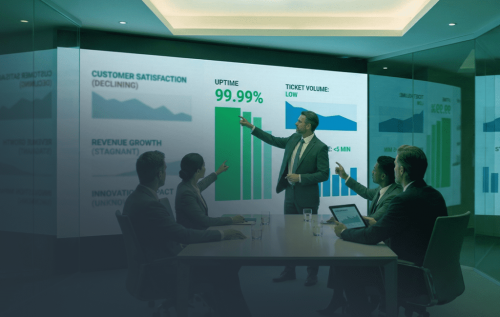
Have you ever looked at an IT metrics report full of green indicators, yet felt that, in practice, the business remains stagnant?
In the past, we evaluated IT in a very straightforward way, almost as if it were the company's maintenance service: if computers were running, costs were controlled, and tickets were resolved, the job was well done. It was a time when technology was just support, almost like electricity. If nothing stopped working, nobody complained.
However, the problem is that the world has changed drastically. Technology has become the heart of strategy, but the ruler we use to measure success remains the same as twenty years ago.
Today, technology is what decides who wins the customer or who falls behind. Even so, many companies still make decisions based on numbers that say nothing about what really matters now. The result is this dangerous paradox: in reports, IT looks super-efficient; in real life, the business loses opportunities due to lack of agility.
Read also: 2025 was the year of AI. 2026 will be the year of intelligent data
IT metrics created for a world left in the rearview mirror
Classic indicators like uptime, ticket volume, or cost per user were born in an era of stability. The mission was to keep everything running smoothly while spending as little as possible. Measuring effort made sense because the work was predictable.
While these numbers help you know if the system didn't crash, they don't answer the questions that really keep managers up at night: Did this generate value? Did this help us grow?
Recent research from MIT Sloan Management Review points out that the wrong KPIs can doom digital transformation efforts. Companies risk achieving success that is not strategic when metrics aren't traceable to business goals, creating a false sense of control while real impact remains invisible.
When KPIs incentivize the wrong behavior
One of the biggest risks of using old metrics is that they shape people's behavior. After all, everyone wants to hit their targets.
In this sense, if the focus is only on reducing costs and closing tickets quickly, that's exactly what the team will prioritize. Consequently, to hit a short-term financial target, the team might postpone an essential modernization. On paper, the cost dropped and the indicator looks good. In practice, the company lost the chance to launch a new product or integrate an AI that would change the game.
McKinsey research on long-term value creation highlights a persistent problem: managers and investors too often fixate on short-term performance metrics rather than on the creation of value over the long term. The same happens in IT when metrics don't capture impact, only effort or volume.
Operational Efficiency is not the same as Strategic Efficiency
To understand where the error lies, we need to separate things:
Operational Efficiency: It's "are we doing well what we decided to do?" (E.g.: The system is stable).
Strategic Efficiency: It's "are we doing the right things?" (E.g.: Does this system actually improve my customer's life?).
This occurs because when IT measures success only by deliveries or cost reduction, it optimizes isolated parts of the system. For example, you can deliver a project on time, but if it's not adopted by users or doesn't solve a customer pain point, it was a waste of resources.
It's the eternal conflict between Output (what you deliver, like code) and Outcome (the real result it generates). Consultancies like Tability and Effective Agile hammer this point home: delivering fast is good, but delivering what generates real change is what defines success in 2026.
The shift to value: new IT metrics
The market has already realized that the performance management model needs to change.
Gartner predicts that, going forward, companies will increasingly use real-time data and AI to predict the impact of IT actions, rather than just looking at the past. Additionally, McKinsey reinforces that IT's role now is to sustain growth, and this requires new metrics, such as:
Time-to-value: How long does it take from idea to the first real result in your pocket?Adoption and Impact: Are people using the solution? Did it facilitate the sale?Return on technology investment: Did what we spent here bring agility or just another system to maintain?
The CIO now plays offense, not defense
For a long time, a CIO's success was measured by their ability to ensure absolute continuity. If systems were operational and the budget didn't blow up, the work was considered impeccable. It was a posture of constant crisis management: the focus was on avoiding failures. However, in 2026, keeping the lights on is just the baseline to enter the field. The real game now happens on offense.
This change transforms the CIO from an infrastructure manager into a true Business Architect. What does this mean in practice? It means they're no longer at the table just to enable what other areas request. They're there to anticipate opportunities: "If we structure our database now, we'll be able to launch this new revenue stream in weeks, not months."
The gold metric has changed: from "delivery" to "capability"
IT stops being evaluated by the volume of code produced and starts being measured by what it enables for the business. The board no longer wants to know how many modules were delivered, but rather:
- Did technology allow the company to quickly pivot its strategy when the market changed?
- Did the structure support doubling the operation without operational costs rising proportionally?
- Did the architecture provide agility to integrate a new AI without having to rebuild everything from scratch?
In summary, if technology is rigid, the company is slow. If technology is fluid, the CIO has delivered to the business the most valuable asset of 2026: adaptability.
To play offense, the technology leader needs to master a new language. They stop talking only about latency and servers to focus on time-to-market, scale efficiency, and reducing friction in the customer journey.
When the board and the technical team start speaking the same language, the perception of IT changes. It stops being seen as a necessary cost center and starts being recognized as the organization's revenue engine. The merit of strategic management isn't having the most complex system, but rather being the most agile company in the sector.
How Mouts IT helps clear this vision
We understand that the problem today isn't the lack of data. The problem is the lack of the right metrics.
At Mouts IT, we help companies escape this KPI labyrinth. We work by redesigning governance and defining indicators that show where technology is really generating value and where it's just keeping the team busy.
More than measuring better, our focus is helping you decide better.
Conclusion: Measuring wrong is expensive
Metrics shape decisions, and decisions shape your company's future. In 2026, insisting on support KPIs for IT that should be strategic is a huge risk.
Companies that evolve their way of measuring manage to align technology with real growth. Those that don't evolve continue being super-efficient but in the wrong direction.
The question that remains is no longer about your IT's speed, but rather: What are your metrics making you prioritize without you realizing it?
If you feel it's time to align technology with your business's real results, Mouts TI can help you with this transition. Let's talk?
Related news
Innovation, the global market and divers topics about the technology universe are currently available on our blog.
 Cases
Cases
Big Data in energy: how to manage data in the energy sector?
The energy sector is one of the fundamental pillars of the global economy, driving everything from large industries to domestic consumption. With the advancement of digital technologies, the amount of data generated in this sector has increased exponentially, making Big Data an essential tool for companies seeking to stand out in a competitive market. But how to collect and analyze this data effectively? And what are the benefits of a well-done analysis?
 Cases
Cases
Energy and sustainability: 3 innovative technologies in the energy sector
Sustainability has become a central issue in the energy sector, driven by the need to reduce environmental impact, ensure energy security and meet growing demands for cleaner energy sources. With increasing pressure to reduce carbon emissions and adopt more sustainable practices, the sector faces significant challenges, but also promising opportunities.
 Cases
Cases
Why is cloud migration important for the energy sector?
Energy market professionals can already see that the sector is undergoing a significant transformation, driven by the need for greater efficiency, sustainability, and innovation. Amid these changes, cloud migration has stood out as one of the main strategies for companies looking to optimize their operations, reduce costs and improve collaboration.